Notturni
Seven works composed in the 21st century by Sebastian Gottschick, who arranges and conducts the Ensemble Fur Neue Musick Zurich, configured as an ensemble with percussion, a sextet, a chamber ensemble with baritone and soprano, and performing himself solo on viola; sophisticated and modern works that employ complex tonality, timbre and playing techniques.
Another Songbook
Conductor Sebastian Gottschick presents an additional selection of songs and chamber music works from composer Charles Edward Ives that reflect this broad range, 20 mostly brief and innovative works composed between 1898 and 1921, blurring the boundaries between genres through unusual motifs, themes, gestures and phrases that appear in new vocal and/or instrumental contexts.

Satoko Inoue Presents Jo Kondo's New Works For Piano
The second album of piano works from Japanese composer Jo Kondo performed by pianist Satoko Inoue--a noted interpreter of solo works by Feldman, Ferrari, and Cage--here presenting all of Kondo's works for solo piano written from 2001 to 2012, alongside two early works from 1975, exploring a wealth of harmonic, rhythmic, and conceptual ideas from a diversity of projects.
Baobab
Co-released with Umland Records, Germany. On one night in 2019, The Dorf (German for "village") took a heavy dose of the music of Phill Niblock. The impact on the musicians, gathering to play a double-length version of Niblock's Baobab and (in a second set) three "Dorf" tunes, was deep. It felt a bit like going to church -- a truly spiritual experience. At first, the audience did not believe the announcement that the "drone" piece would last for 46 minutes. Afterwards, their reactions showed the…
Hyazo
A new album from the trio who released Tse in 2016, and - along with violinist Angharad Davies - Awire in 2018. Three compositions of quiet and delicate beauty, two by Christoph Schiller, and the title track by Cyril Bondi.Cyril Bondi: Indian harmoniumPierre-Yves Martel: viola da gambaChristoph Schiller: spinet
Antifona
Following on from the wonderful "Cantilena", four new chamber works by the Paris-based Italian composer Giuliano d'Angiolini. Performers include Apartment House, Manuel Zurria, Mark Knoop and the composer.
Gruppo di Construzione
Małe Instrumenty (Small Instruments) are a band exploring new sounds using a wide array of small instruments. The instruments used in their sonic experiments feature an ever expanding array of professional instruments, sound toys made for children or naive in nature, strange musical inventions as well as a whole array of small items that aren't really instruments but do make a sound. The music created in this way reveals unique colours of sound sometimes beautiful and fine, sometimes surprising …
Metamorphoses (Book I) / Five Pieces for Piano
George Crumb's earliest and most recent piano works on one CD: the first recording of Metamorphoses (Book I), ten pieces after famous paintings written for Margaret Leng Tan, and the Five Pieces for Piano (1962).

Desert Plants
Facsimile reprint of Walter Zimmermann's book Desert Plants, his interviews with American experimental composers from a 1976 trip to America
Complete Piano Works
All of Morton Subotnick's piano music on one disc for the first time, with four first recordings, including Liquid Strata and The Other Piano with electronics, played by SooJin Anjou and supervised by the composer.
Dispersion
Elliott Sharp's Dispersion: Flexagons, Dispersion of Seeds, The Hidden Variable and Palimpsest, four processes-based works for large ensemble, played by the young musicians of Veni Academy under Marián Lejava, with Sharp on electroacoustic guitar.

Killer Instincts
Soprano Sarah Maria Sun and The Gurks perform fifteen songs about bad people doing bad things, from Bernstein, Weill, Tom Waits and Joe Walsh to Schubert, including the first recording of Stefan Wolpe's Hitler.
Works for Flute
Roberto Fabbriciani plays the complete flute works of Henri Pousseur, including Flexions I, Éclipticare and Zeus joueur de flûtes with live electronics by Alvise Vidolin, plus the 1957 tape piece Scambi.
Terra che Cammina
"We know Belgian-based pianist Giovanni Di Domenico from his album with Tetterapadequ, and his recent collaboration with Alexandra Grimal, Seminare Vento. On this album, he is joined by John Ruocco on clarinet, Ananta Roosend on violin, Anja Naucler on cello, Claus Kaarsgaard on bass.The music is slow, intimate, precise, and quite expressive. The album starts with solo piano, an eery melody, with sparse notes of the right hand repeating a bluesy phrase. Yet it starts for real with the second pie…

Two Paths With Active Shadows Under Three Moons and Surveillance
"This piece and group developed over the course of a year. It was presented in concert over three initial phases. The concert recorded here (second phase) occurred six months into this process. However, this is not completely accurate; in different forms, the group continues to develop. This recording documents one of many possible manifestations."With: Marcia Bassett, Barry Weisblat, Ron Stabinsky, Che Chen, Laura Ortman, C. Spencer Yeh, Michael Bullock, Andrew Lafkas, Rick Brown, Ryan Sawyer, …
Augmented Study (2012)
**200 copies** "This is a study version composed in the studio from a single recording of a violin glissando. It was never intended to be performed live. The final version for 7 violins was the result of this study.""A single recording of the violin glissando of Johnny Chang has been turned into a multi-track recording. Here one violin becomes sixteen. Peter Ablinger’s Augmented Study Serie is focused on 'tension between redundancy of material and complexity of experience'. Because this work is …
Unconscious Collections
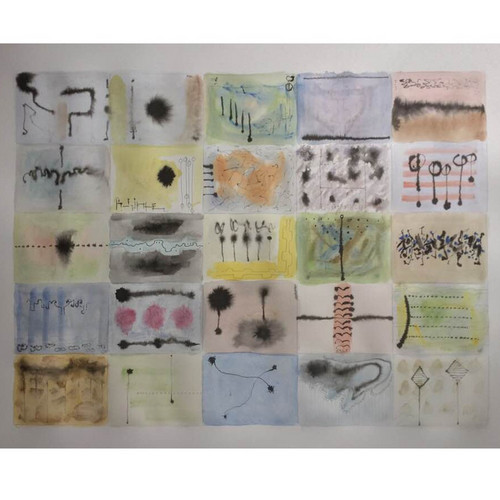
Unconscious Collections emerges as a resonant dialogue between Tomás Cabado’s classical guitar and Christoph Schiller’s prepared spinet, both artists known for their work within experimental, microtonal, and Wandelweiser-inspired aesthetics. The album consists of pieces co-composed and performed by the duo, recorded during a period of close collaboration in Switzerland. Through a process that blends score-based direction and improvisational openness, Cabado and Schiller achieve a rare degree of …
Ricercar nell’Ombra
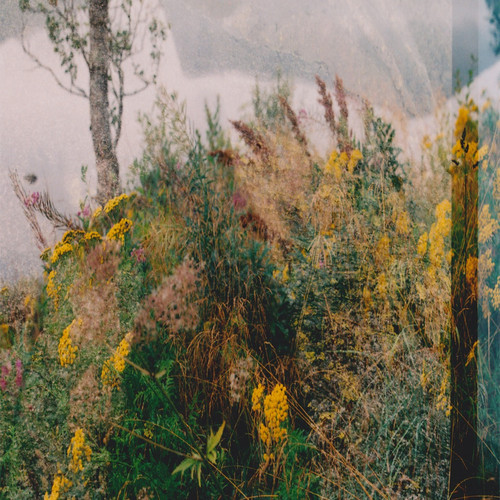
Ricercar nell’Ombra grew out of a collaboration between French composer Emmanuel Holterbach and the seven-member Florence-based ensemble Blutwurst, both devoted to the acoustic investigation of slowly transforming sonic patterns. Conceived during residencies at Villa Strozzi and other venues across Florence, the project sets out to pay homage to Italian music history while inventing new forms through a deeply collaborative method. Holterbach’s admiration for Italian music across centuries led hi…
Chamber Works
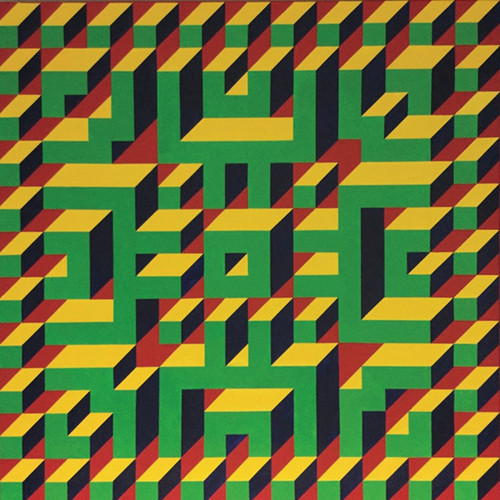
Luiz Henrique Yudo’s Chamber Works marks an insightful journey into the translation of visual art into sound, presenting music that bridges architecture, painting, and sculpture with contemporary chamber idioms. Brazilian-born and Amsterdam-based, Yudo composes using an original approach that is self-taught, drawing inspiration from structures, patterns, and artworks he admires. The album’s five works are performed by Apartment House, a leading ensemble in contemporary experimental music. Their …
Piano Works
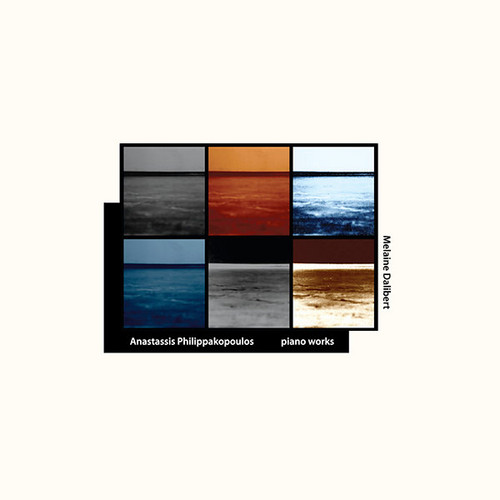
The French pianist and composer Melaine Dalibert possesses an exquisite touch and engagement with his repertoire. On this new album he tackles the stripped-down music of Greek composer Anastassis Philippakopoulos, a key member of the post-Cagean Wandelweiser Collective, tracing out the delicate, sparsely mapped notes from a dozen contemplative, spacious miniatures. The pieces are built around austere melodic fragments, all of which hang pregnant in the air, unfolding carefully before the next p…