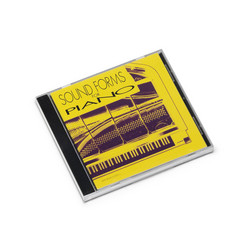
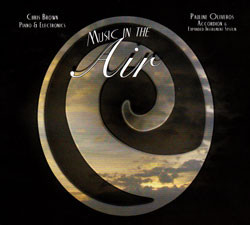
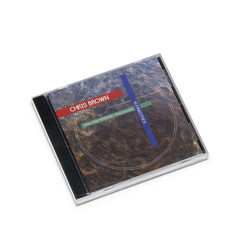
CD, New World Records, 2016. Six pieces, fifty-one minutes, for a solo grand piano retuned by the composer. The tuning is thirteen-limit just intonation, and the six prime numbers of the title, 2, 3, 5, 7, 11 and 13, govern everything at once: the pitches, the harmony, the rhythmic subdivisions and the length of every section. Of the twelve retuned degrees, one has the prime factor 2, three have 3 as their highest prime, and two each have 5, 7, 11 and 13. Between them those twelve notes produce seventy-five distinct intervals. Equal temperament gives twelve.
Each movement is titled with four of the numbers, and only those four are active in it, which restricts the pitch material to an eight-note mode and simultaneously sets the rhythmic subdivisions, since the same integers do both jobs. The length of each section in bars is the sum of those numbers. Chris Brown has said he used that degree of algorithmic control over form partly to avoid the single-centre pull that modal music tends to have, and that playing asymmetrical rhythms in odd-numbered subdivisions of a strong pulse can produce something close to a bebop swing.
Two facts make the record more unusual than it looks. Brown worked as a professional piano tuner for around fifteen years, and tuned the instrument himself, by ear, using harmonics from the low strings and checking against an electronic tuner where the relations were too high to hear. It takes a couple of tunings to settle and does no harm to the piano, since the total string tension is unchanged. And the scale itself was given to him by Ellen Fullman, who then engineered the recording.
Brown was born in Illinois in 1953, spent four childhood years in the Philippines, took his first piano lessons from Bartok's Mikrokosmos, and was a founding member of The Hub, the computer network band, in 1986. He spent a year simply getting used to the tuning before he wrote anything in it.
"I employed this algorithmic control over form in part to evoke the egalitarianism of twelve-tone music, and to divert from monocentric tendencies of modal musics. Within that form, however, I allowed myself to compose freely, using a diversity of melodic, harmonic, and polyphonic ideas. Lou Harrison's endlessly branching melodies, Cowell's polyrhythms and tone clusters, Cage's equanimity and Stockhausen's deterministic force, the complex minimalism of Morton Feldman, and the harmonious buzz of Ellen Fullman . . . all provided influence and inspiration. I discovered that playing asymmetrical rhythms in odd numbered subdivisions of a strong pulse can evoke a bebop-like swing. And although I never thought about it during the composing process, I think I hear in its mixture of styles an influence of Ives." - Chris Brown